
Imbolc / First Stirring
Southern Hemisphere — July 25, 2026
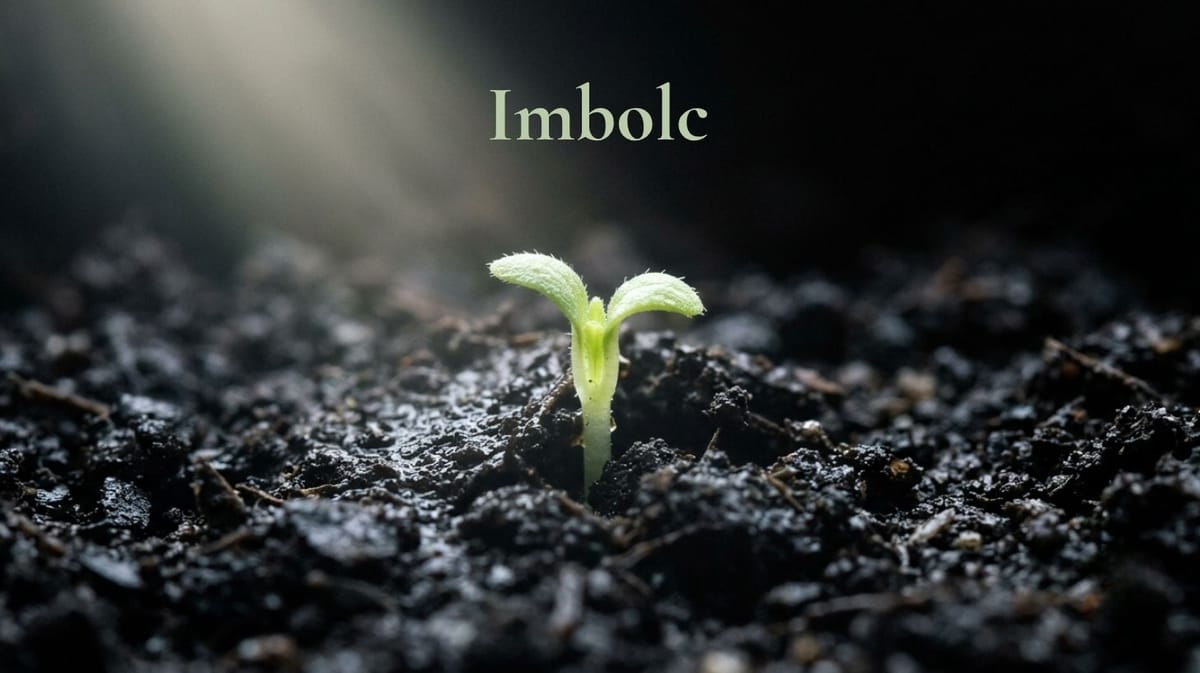
It is the end of July in the Southern Hemisphere.
The winter solstice has just passed — the longest night is behind you now, the light has already begun its slow return, even if the cold hasn’t gotten the message yet.
The ground is still hard. The mornings are still dark at the edges. But underneath the frost, underneath the soil that looks like nothing is happening, something has already made a decision.
The Wheel calls this moment Imbolc.
February 1st in the Northern Hemisphere — but the Wheel is not a date on a wall calendar. It is a relationship with what the earth is actually doing where you actually live.
And right now, in the Southern Hemisphere, what the earth is doing is the same thing it does in the North in early February:
It is stirring.
Imbolc comes from the Old Irish — possibly i mbolc, meaning “in the belly,” referring to the pregnancy of ewes, the first animals to show signs of new life at the turning of winter.
The lambs are not born yet. The flowers are not blooming yet. The warmth has not arrived.
But something is pregnant with possibility. Something is in the belly of the earth that was not there three months ago.
The stirring is the thing. Not the arrival — the stirring.
THEN
This day belongs to Brigid.
In the Pagan tradition, Brigid is the goddess of fire and poetry and healing — the keeper of the sacred flame at Kildare that burned for centuries tended by her priestesses, never going out.
In the Christian tradition, she is Saint Brigid of Kildare — February 1st, the same day, the same fire, the same woman underneath two names.
The church absorbed her so completely that they kept the date, kept the fire, kept the sacred well, kept the cross she wove from rushes that still hangs in Irish homes today.
You cannot fully separate them. You are not supposed to.
She is the fire that burns at the edge of winter and says: not yet, but soon.
She is the poet who names things before they exist. The healer who tends what is fragile before it is strong. The smith who works with fire to make something that will last.
And in the Islamic tradition, there is a concept called fitrah — the original nature, the innate disposition toward the sacred that every human being is born with, that cannot be destroyed, only obscured.
The stirring of Imbolc is the fitrah asserting itself after winter.
The thing in you that was always there, always oriented toward the light, beginning to remember itself.
Different traditions. Same understanding:
Something in you is turning toward the light even before the light has fully arrived.
NOW
While the Northern Hemisphere today is cutting what it grew — naming the harvest, acknowledging what came through — you are at the other end of the arc.
You are not harvesting yet. You are watching for the first green thing.
The animating question of Imbolc is not what did you grow?
It is: what is first stirring?
The smallest, most fragile new thing. The idea that has been forming in the dark that you haven’t told anyone about yet. The practice you started quietly, tentatively, not sure if it would take. The direction you have been turning toward without fully committing to the turn.
That is your Imbolc.
Today — in the Southern Hemisphere’s midwinter — Brigid’s fire is already burning at the edge of your season.
It is not asking you to arrive. It is not asking you to have it figured out. It is asking you to notice the stirring.
To name the fragile thing. To tend it the way you’d tend a fire that has just caught — carefully, without smothering it with too much too soon, without exposing it to a wind it isn’t strong enough to survive yet.
Find the first stirring. Tend it.
It knows what it’s becoming even if you don’t yet.