
Onam
The Demon King Kerala Still Welcomes Home
I’ll be honest with you upfront. Here in the West, most of us know almost nothing about Hindu tradition beyond a handful of surface images. So let’s actually learn something today instead of pretending otherwise.
Onam is a harvest festival, celebrated primarily in Kerala, in South India, marking the first month of the Malayalam calendar. And underneath the flowers and the feasting is a story worth sitting with carefully.
Long ago, Kerala was ruled by a king named Mahabali. He was what Hindu tradition calls an asura, a being often translated simply as demon, which already tells you something about how easily this story gets misread if you stop at the label.
Under Mahabali’s rule, the kingdom was remembered as a golden age. No poverty. No falsehood. No inequality. Everyone was said to be equal, prosperous, and safe.
This worried the gods. An asura’s kingdom thriving that completely, rivaling the order the devas were supposed to maintain, was seen as a problem. So Vishnu took the form of a dwarf Brahmin named Vamana and came to Mahabali asking for a gift: as much land as he could cover in three steps.
Mahabali’s own teacher warned him something was wrong, that this humble request concealed something larger. Mahabali agreed anyway, because he had given his word, and a king who keeps his word even against his own interest was, in this story, exactly the kind of king worth being.
Vamana grew to cosmic size. One step covered the entire earth. The second covered the heavens.
For the third step, with nowhere left to place it, Mahabali offered his own head.
He was pushed down into the netherworld.
But Vishnu, moved by the completeness of his integrity, granted him one gift in return: once a year, he could come back. Return to Kerala. See his people again.
Onam is that homecoming.
WHY IT MATTERS TO YOU TODAY
Notice what this story actually does with the categories most of us walk in assuming are fixed.
The “demon” is the just, generous, egalitarian ruler. The god wins through a technicality, a gift request that conceals its true size until it’s too late to refuse. And the ending isn’t really a defeat. It’s an annual return, celebrated every single year with more devotion than most actual victors ever receive.
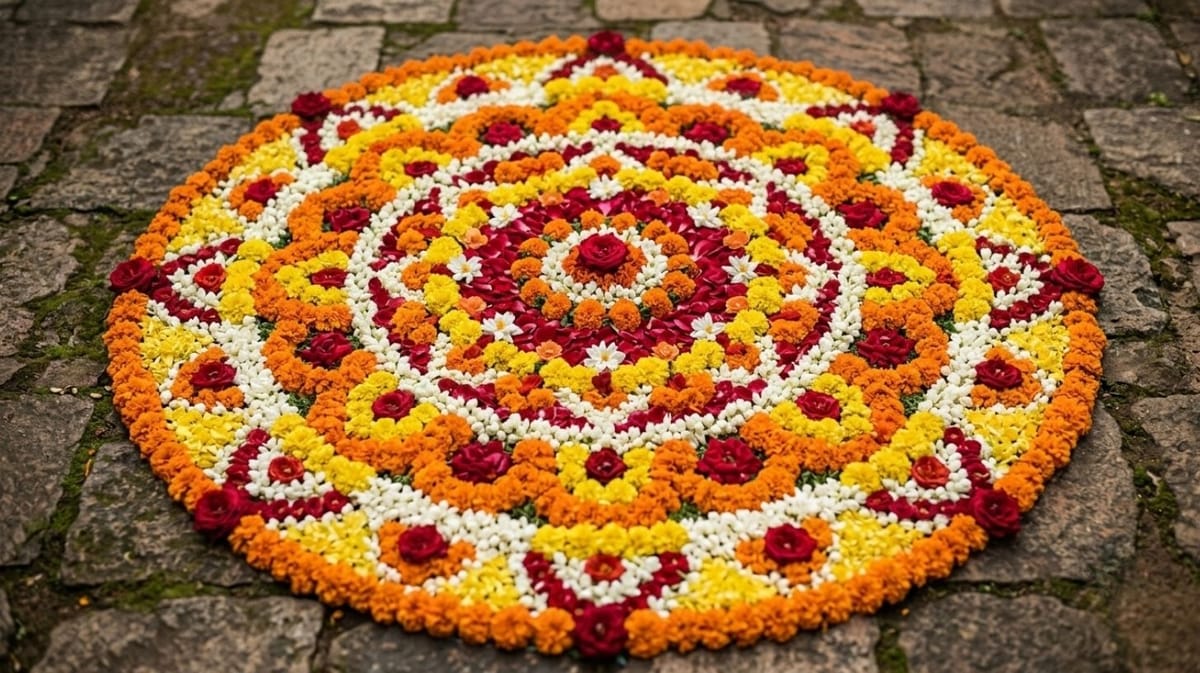
Kerala doesn’t remember Mahabali as a cautionary tale. They remember him as a beloved ruler still worth welcoming home. Elaborate flower patterns, called pookalam, are laid out to greet him. An enormous feast, the Onam Sadhya, is served on banana leaves, sometimes running to more than twenty dishes. Boat races, traditional dances, new clothes for the whole family, all of it in preparation for a king who technically lost everything and is still invited back every year like nothing was ever lost at all.
I think there’s something genuinely useful in a story willing to complicate its own hero and villain this thoroughly. The being labeled demon is the one who kept his word at total personal cost. The being labeled god wins by hiding the true size of his request until his opponent has already agreed to it.
And the response to all of that isn’t outrage or permanent exile. It’s an open door once a year, flowers laid out, a feast prepared, room made at the table for someone the official story might have written off entirely.
I don’t know Hindu tradition well enough yet to tell you everything this story is supposed to mean. But I know what it means to me, learning it for the first time: that integrity can outlast the loss it costs you, and that a community can choose, deliberately, every single year, to welcome someone home instead of letting the labels decide who deserves it.