
Tu B'Av — The Jewish Day of Love
Can You Actually See Them?
Tonight’s full moon is the Buck Moon — antlers still in velvet, still soft, still growing into whatever they’re going to be. If you caught this morning’s Vigil, you already know I’ve been thinking about young bucks, motivated and clumsy and not yet hardened into who they’re becoming.
Today is also Tu B’Av — the fifteenth of Av, sometimes called the Jewish day of love.
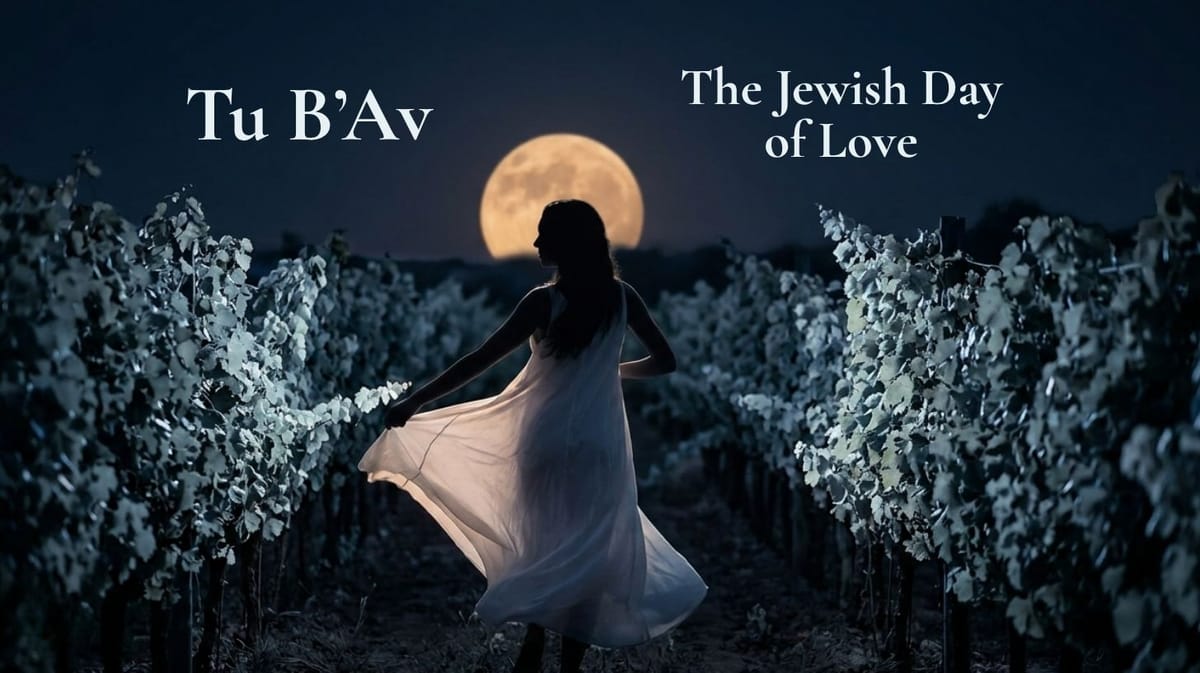
In the Mishnah, it’s described this way: on this day, the unmarried women of ancient Israel would go out and dance in the vineyards, wearing borrowed white garments, specifically so that no one could tell who was wealthy and who wasn’t. The unmarried men would come and choose.
But the instruction given alongside this custom was explicit: look past beauty. Look past family name. Look for character. The dancing in borrowed white was designed to strip away every easy signal so that what remained was the actual person.
A whole courtship ritual built around one idea: can you actually see them? Or are you only seeing what they’re wearing, what they have, what everyone else already sees?
I’m autistic and ADHD. I’ve spent most of my life managing something called Rejection Sensitive Dysphoria — RSD — which is exactly what it sounds like. The fear of rejection isn’t a mild discomfort. It’s closer to actual pain, sharp enough that people like me learn, without meaning to, to withdraw, to people-please, to simply never ask rather than risk finding out the answer is no.
I met my wife when she was working as a cashier, the night before I left to fly to California and marry my first wife. I almost canceled the trip. I almost asked her out instead. I didn’t. She had a boyfriend. I didn’t know that.
Seven years later, I crossed her path again — a storm stranded us at the same gas station in South Georgia, somewhere on the way to Alachua. Attracted. Not connecting.
Two years after that, I found her again — on a dating website. Three of them, actually. I hit her profile on all three, and hounded her for about a month before she finally responded. We hit it off immediately. I still didn’t realize this was the same woman from the cash register, from the storm, from nine years of almost.
When I finally met her in person, I just stood there. The RSD, probably. The same freeze that had kept me quiet at that register nine years earlier.
She had to ask me directly: Are you going to kiss me, or just stand there?
We have not been apart since. It took two more days before it fully clicked that this was her. The same woman. Three times. Nine years.
I think about Tu B’Av and its instruction to look past the surface and actually see the person standing in front of you, and I think about how long it took me to actually see her — three separate times, close enough to touch, before the seeing finally happened.
The ancient tradition stripped away wealth and status so people could see clearly. My own nervous system stripped away my ability to act even when I could see clearly. Different obstacles. Same ancient problem: it is entirely possible to stand three feet from exactly the person you are looking for and not see them at all.
If you have RSD, if you have ever frozen at the exact moment that mattered most, if you have ever let someone walk past you because the fear of asking felt larger than the cost of never knowing — Tu B’Av is for you too.
Not just the ones dancing confidently in the vineyard. The ones standing at the edge, wanting to dance, wanting to be seen, wanting to see someone else clearly, and finding it almost impossible to close that last small distance.
Sometimes it takes nine years. Sometimes it takes three collisions before the seeing finally happens.
That’s not a failure. That’s just how long some antlers take to harden.