
The Alarm In The Temple
It's 5am and the weight is on your chest again — and nothing is wrong. A thought for anyone who has tried everything to make it stop.
I want to take you back to a specific kind of morning.
Not a dramatic one. Not the kind where something has obviously gone wrong, no phone call in the night, no news you weren’t expecting. Just an ordinary morning. The alarm goes off, or maybe you beat it. The light comes through the curtains the same way it always does. And then, before you are fully awake, before you have had a single coherent thought, it arrives.
A weight on your chest. Not metaphorical. Physical. Like someone set something heavy there while you were sleeping and walked away without explaining why. Your heart is going faster than it should be for a person who is just lying in bed. And underneath all of it, a feeling that something is wrong, something is terribly, urgently wrong, except you cannot tell me what it is, because there is nothing. Nothing is wrong. Which somehow makes it worse.
I know that morning. I have had that morning more times than I would like to count.
And for years, I handled it the way I had been taught to handle it. I prayed. Hard. I commanded the feeling to leave in the kind of authoritative voice that is supposed to work. I reminded myself of everything I knew, everything I had studied, earned, and lived, and I told myself firmly that a person with my particular resume had absolutely no business feeling this way. A man who had read every theologian worth reading. A man who had stood in places where the air smelled like cordite and fear and had kept moving anyway. A man who was, technically, old enough to know better.
And the anxiety, completely unimpressed with my credentials, stayed right where it was.
The shame of that was its own weight on top of the first one. Because I didn’t just feel panicked. I felt panicked and wrong for feeling panicked. Which, if you’ve ever tried it, is not an improvement.
And then one morning, I don’t know exactly which one, they blur together after a while. I stopped fighting it. Not because I had figured something out. I was just tired. I sat on the edge of the bed in the early quiet, and instead of commanding the feeling to leave, I did something I had never thought to do before.
I asked it a question.
What are you trying to tell me?
And that question, that small, quiet, slightly desperate question, changed everything about how I understood what was happening in my own body. Not immediately. Not with a lightning bolt. But it cracked something open that I had been keeping locked for a very long time.
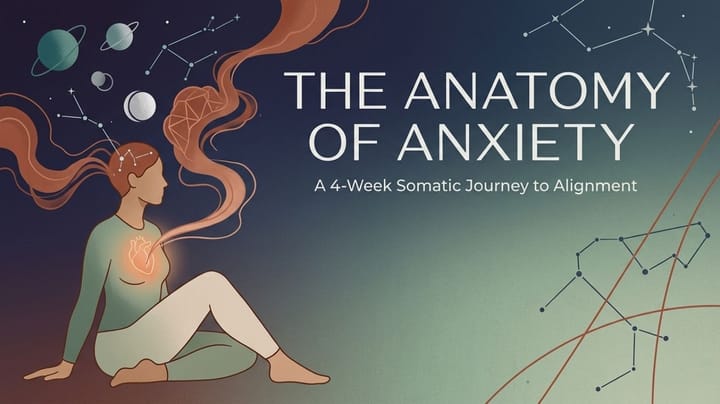
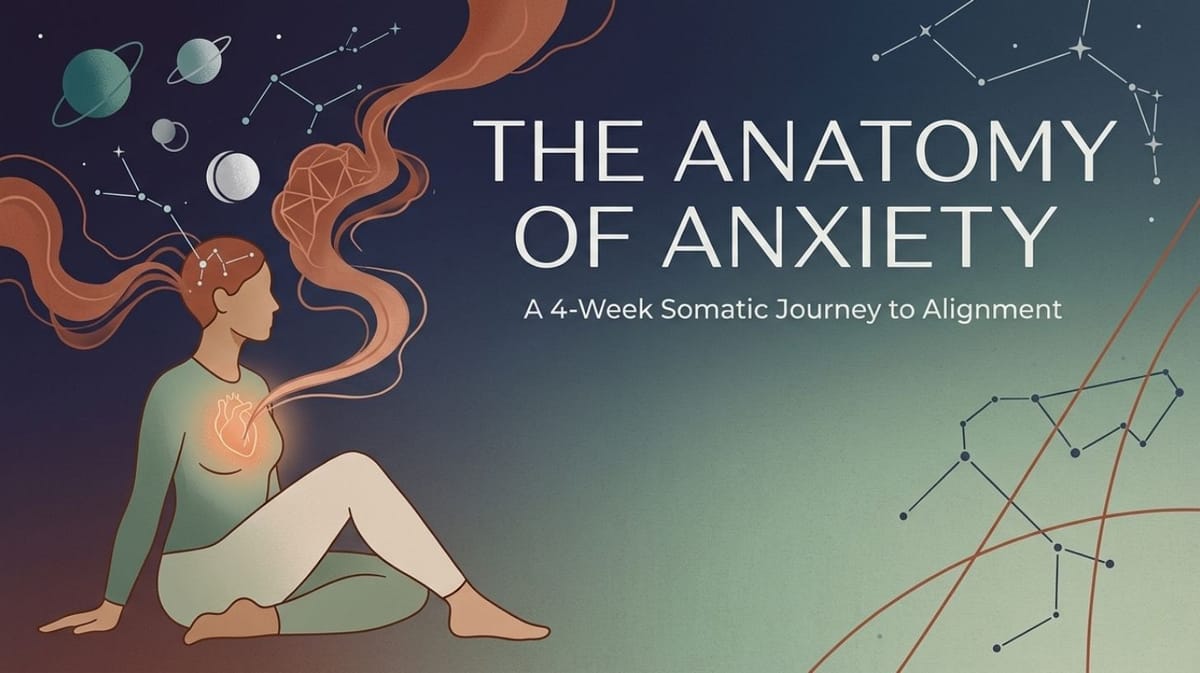
That’s what this series, The Anatomy of Anxiety, is about.
Here’s what I know about where you are right now.
You are living in the most anxious, hyper-stimulated society in the entire history of human civilization. That is not a rhetorical flourish. That is the clinical consensus of virtually every mental health researcher working today. The baseline level of nervous system activation that the average person is walking around with right now would have been considered a crisis state in any previous era of human history. And if you don’t believe me, you should look up George Carlin’s bit on how Shell Shock became PTSD. We have normalized a level of internal alarm that is, by any reasonable measure, not normal.
And we are handling it badly. Not because we are weak. We are not weak. But because we have been handed the wrong tools and told they are the right ones. We were given a hammer when sometimes we needed a screwdriver. You can take that multiple ways.
On one side, you have Gen X, my generation. We handle panic the way we handle most things: quietly, efficiently, and alone. We built our identities around functionality. If you are functional, if you are showing up, producing, managing, then by definition you are fine. The anxiety doesn’t go away. It goes underground. It becomes the tight jaw and the third glass of wine and the sleep that never quite restores you. We are not in crisis. We are just permanently, quietly braced.
On another side, you have Millennials, who were handed the self-care revolution and told it would help. And some of it does. But there is a particular cruelty in an industry that monetizes your wellness while simultaneously increasing your cortisol. The meditation app sends you a notification. The breathwork subscription has a cancellation fee. The optimization of anxiety has become its own source of anxiety, and the people who were supposed to be helped by it are drowning in the very tools designed to save them.
And then there is Gen Z, who are carrying something the rest of us didn’t face at their age: a nervous system that was formed in the constant presence of global catastrophe delivered directly to a four-inch screen. Their baseline isn’t calm with occasional disruption. Their baseline is disruption. Their nervous systems have been trained, from adolescence, to treat the world as a source of continuous threat. The mental health crisis among young people right now is not a character flaw. It is a reasonable response to an unreasonable amount of signal.
Here is what all three of these groups have in common: we treat the anxiety like a structural defect. Like something in us is broken. Like the alarm going off is the problem, rather than what the alarm is trying to tell us.
We try to mute the smoke detector. We never look for the smoke.
What changes when we stop treating our anxiety as a personal failure and start treating it as an intelligent messenger from the deepest part of who we are?
That’s the idea we’re working with. Sit with it for a minute, because it changes everything downstream.
This is not a new idea. People have been trying to tell us this for a very long time, in languages and frameworks so different from each other that the agreement between them ought to get our attention.
Let me introduce you to two voices. They come from very different worlds. But they arrive at the same place.
The first is an ancient text called the Gospel of Truth.
Now, before you decide how you feel about that, let me tell you what it is, because it’s probably not what you’re picturing. The Gospel of Truth is one of the documents discovered in 1945 near a place called Nag Hammadi in Egypt, buried in a sealed jar in the desert, where someone had hidden it roughly sixteen hundred years earlier. It belongs to a collection of writings associated with the Gnostics, a diverse and frequently persecuted movement of early spiritual seekers who believed that the path to liberation ran through self-knowledge rather than institutional obedience. They were, to put it gently, not popular with the establishment. Which is part of why their texts ended up in a jar in the desert.
The Gospel of Truth was most likely written in the second century, possibly by a theologian named Valentinus, who was by all accounts one of the most brilliant minds of his era. And in it, he writes something that stopped me cold the first time I read it:
“Ignorance brought about terror and frantic fear. And terror became dense like a fog, so that no one could see. Thus error found strength... But when knowledge appears, the terror vanishes.”
Read that again slowly. Ignorance brings terror. Terror becomes a fog so thick you can’t see through it. And the fog doesn’t lift through willpower, or suppression, or the right medication, or enough positive thinking. It lifts through knowledge. Through seeing clearly what is actually there.
The Gnostics were not saying that anxiety is an illusion. They were saying that anxiety is what happens when we are cut off from our own inner truth. The terror is not random. The fog is not permanent. It is what arrives when we are refusing, or unable, to see something we need to see. And when the seeing happens, when the knowledge comes, the terror doesn’t fight back. It simply dissolves.
The second voice is considerably more recent, and comes not from a desert jar but from a therapist’s office in Chicago. His name is Richard Schwartz, and in the 1980s he developed a psychological framework called Internal Family Systems, or IFS.
Schwartz, working with clients over many years, began to notice something that didn’t fit the models he’d been trained in. When people experienced anxiety, depression, or panic, it wasn’t random noise. It had a logic. It had an intention. The anxious part of a person wasn’t malfunctioning. It was protecting. It had learned, usually very early in life, that something was dangerous. And it was doing its level best to keep the person safe from that thing, even when the original threat was long gone, even when the protection was causing more harm than it was preventing.
Schwartz called these parts protectors. And he made a radical therapeutic move: instead of trying to eliminate them, he taught people to talk to them. To get curious about them. To ask them, with genuine compassion, what they were afraid would happen if they stopped doing what they were doing.
What he found, consistently, was that the anxious protector wasn’t the enemy. It was a messenger. Sometimes a frantic, exhausting, overbearing messenger, but a messenger nonetheless. It was hijacking the nervous system not to destroy the person, but to scream that a boundary had been crossed, a truth had been buried, or an old wound was being reopened and nobody was paying attention.
The Gnostic mystic and the Chicago therapist, separated by nearly two thousand years, are saying the same thing.
The alarm is not the enemy. The alarm is the message.
You don’t get angry at a smoke detector for making noise. You don’t take it off the wall and throw it in the yard so you don’t have to hear it anymore. You look for the smoke.
The most sacred, most intelligent part of you, call it your soul, call it your nervous system, call it your inner self, call it whatever word doesn’t make you flinch. That part will use your physical body to get your attention. It will tighten your chest. It will race your heart. It will wake you up at three in the morning with a dread you cannot name. Not because something is wrong with you. Because something in your life is out of alignment and your deepest self is not going to let you ignore it forever.
So here is the practical question. Not the theological one, not the psychological one. The one you take home with you today.
What if you stopped trying to fix the panic, and started trying to hear it?
I know that sounds simple. It is not simple. It is actually one of the harder things I have ever asked a nervous system to do, including some things I did in places where the stakes were considerably higher than a Sunday morning. Because everything in us is trained to treat discomfort as the problem to be solved. We reach for the phone. We reach for the drink. We reach for the busyness, the noise, the next thing on the list. Anything that interrupts the signal long enough for us to pretend we didn’t receive it.
But here is what I want you to try. Not forever. Just the next time it happens.
The next time your chest tightens. The next time the wave of dread arrives out of nowhere in the middle of an ordinary afternoon. The next time you wake up with that weight and that racing heart and that sourceless sense of wrong: don’t fight it. Don’t reach for the thing that mutes it. Instead, do something that will feel strange and possibly a little foolish.
Put your hand on your heart. Actually put it there, physically, right on your chest.
And speak to the anxiety the way you would speak to a frightened child. Because that, functionally, is what it is. It is a part of you that learned very early that something was dangerous, and it has been trying to protect you ever since, and it has never been spoken to kindly, and that kid’s exhausted.
Say this, or something like it, in whatever words feel true:
I feel you. Thank you for trying to protect me. What are you trying to warn me about right now?
And then, and this is the important part, listen. Not for a voice. Not for a dramatic revelation. But look, honestly, at what is present in your life. Is there a relationship that you know is costing you something you cannot keep paying? Is there a truth you have been refusing to face because facing it would require a change you’re not ready to make? Is there a boundary that has been crossed, repeatedly, that you have been absorbing in silence?
The smoke detector doesn’t always tell you where the fire is. But it tells you there is one. And that is where you start.
I want to leave you with a picture of what it looks like when a community actually lives this way.
Imagine a group of people who don’t pathologize each other’s pain. Who don’t hand each other the name of a doctor or a breathing app the moment someone admits they’re struggling. Who have learned, together, to ask a different first question, not what’s wrong with you but what is your pain trying to tell you? Who sit with each other in the alarm rather than rushing to silence it. Who have learned to read the map of their own internal signals well enough to help each other find the way back to alignment.
That community is possible. It requires a different posture toward suffering than the one most of us inherited. But it is possible.
And here is the thing I keep coming back to, the thing that steadies me on the mornings when the weight is back on my chest and the questions haven’t resolved themselves yet: in the vast, silent expanses of everything that exists, your panic is a tiny, temporary storm on a beautiful, floating rock. The cosmos is not alarmed by your alarm. The stars are doing exactly what they have always done. And the inner spark that is generating this signal, the part of you that loves you enough to refuse to let you stay lost. That spark is safe. Even when your body doesn’t feel safe. The messenger is not the danger. The messenger is the way home.
Anxiety is not your identity.
It is your alarm system.
Stop fighting the noise.
Decode the message.
And let your distress guide you back home to peace.