
The Ones Who Filled The Cup
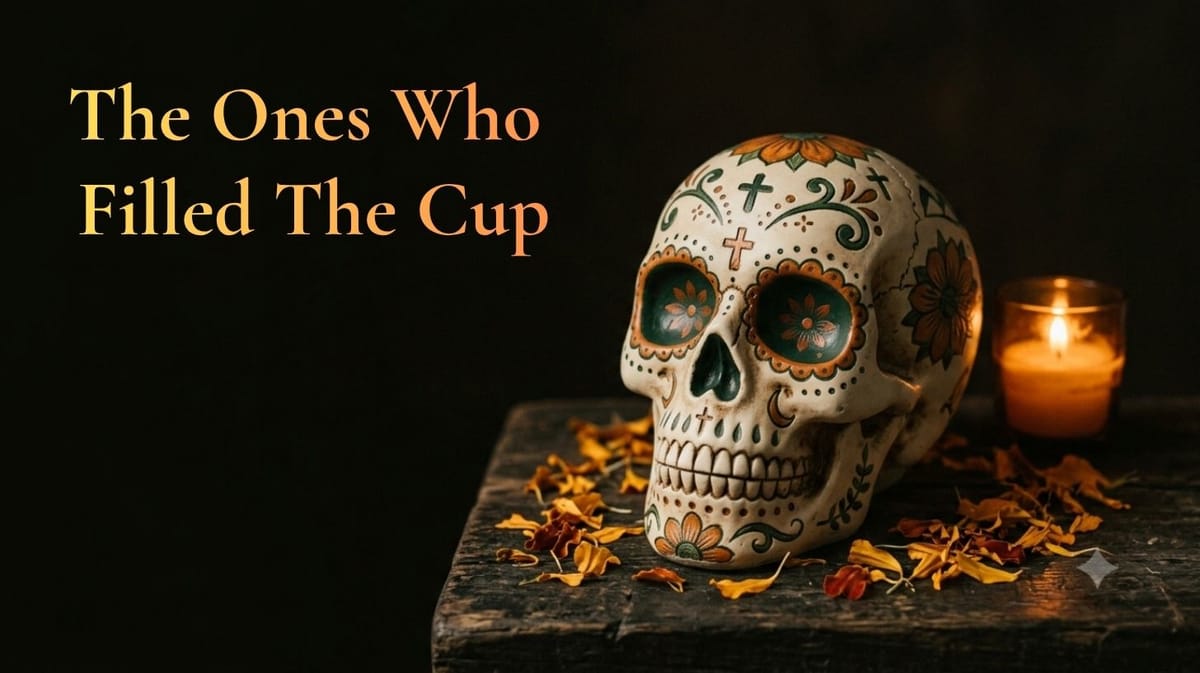
Día de los Muertos / All Saints' Day. An ofrenda for eight people who shaped one life — and the question they left behind: are you filling someone's cup right now?
There is a table in my mind that I have been building for a long time without knowing I was building it.
It has a small brown paper bag on it, stamped in ink — EDWARDS ROASTED PEANUTS — the letters slightly uneven because the hand that stamped it was small, and the hand that guided it belonged to a widow named Elsie who kept four beehives in her backyard and ran a roasted peanut business and was more grandmother to me than either of the two I was issued at birth.
There is a bracelet on the table. Silver, worn, the kind of thing you’d notice on a wrist before you noticed the face above it. It came through a car window on Peachtree Street in Atlanta, sailed from the wrist of a rock musician on a motorcycle to a woman in a passing car who was over three hundred pounds of pure, undiluted heart, and she caught it, and she kept it, because that’s what happens when you’re fully alive — the universe occasionally throws you something to match.
There are guitar picks on the table. Scattered, the way they always end up. In the case, on the amp, in the pocket of a jacket that hasn’t been worn since. They belonged to a man who played Chet Atkins fingerstyle like it was a second language, who recorded gospel with the Golden Gate Quartet, who once drove his prized Mosrite guitar to the man who built it because if something is worth having it’s worth taking care of properly. My father. All Welsh, all Celt, all North Georgia, all guitar.
And there is a pocket tin of Prince Albert tobacco on the table, with a TOP rolling paper half-finished inside it, the way you might leave it if someone called you away mid-lesson. My grandfather John David rolled his own until his hands wouldn’t let him anymore. He taught me to roll mine. He was a prisoner of the Germans at the Battle of the Bulge. He wore my 82nd Airborne hat for the rest of his life. He chewed strawberry Ensure containers with me and traded them to a nurse who didn’t want him smoking, so we could slip away together and smoke Marlboros in the parking lot like co-conspirators.
This is an ofrenda.
In the Mexican tradition of Día de los Muertos — the Day of the Dead, observed on November first and second, the same days the Catholic calendar marks as All Saints’ and All Souls’ — families build altars for their dead. Not to mourn them. Not to perform grief for an audience. But to welcome them back. The marigold petals laid in a path from the door lead the dead home by smell, because marigolds are their flower. The food on the table is what they loved in life, because the dead get hungry too. The photographs prove they were real. The objects prove they were specific — that they were not just someone’s grandmother, but this grandmother, the one who kept bees and stamped peanut bags and let a child help.
I am not Mexican. But I am a Texan by choice and conviction — I wasn’t born here, but I got here as soon as I could — and I claim San Antonio as my hometown. In San Antonio, Día de los Muertos is not an exotic tradition you encounter in a museum. It is November, full stop. It is the smell of cempasúchil on the sidewalk and pan dulce in the window and candles burning on ofrendas in houses you pass on the way to wherever you’re going. You don’t have to be Mexican to have been shaped by a city where this is simply what the first of November looks like. I come to it the way I come to most things — as a wayfarer who encountered something true and sat down with it, in a city that made sitting down with it feel like the most natural thing in the world.
And what I found, sitting with it, is that I have been building this table my whole life. I just didn’t have a name for it until now.
You have a table too.
I don’t know what’s on it. I don’t know whose photograph is there, whose object is sitting next to the marigolds, whose specific and unrepeatable presence you feel most sharply at this time of year when the light changes and the air carries that particular quality of something ending.
But you have one. Everyone does.
The tradition of honoring the dead at the turning of the year is not Mexican. It is not Catholic. It is not Pagan, though the Celts observed Samhain at this same threshold, this same thinning of whatever membrane separates the living from the dead. It is not any one culture’s property, because it is older than all of our cultures put together.
Every human community that has ever existed has found a way to mark this. The ancestors matter. The dead are not entirely gone. The ones who shaped us deserve a place at the table even after they leave it.
What changes from tradition to tradition is not the impulse. It’s the objects. The food. The flower. The specific detail that proves this particular dead person was real and not just a category.
In the Jewish tradition, you light a candle — the yahrzeit candle, burning for twenty-four hours on the anniversary of the death. In the Chinese tradition, you burn paper offerings — houses, money, objects — so the dead have what they need in the next world. In the Christian tradition, you pray for the souls of all the faithful departed, the ordinary ones, not just the saints. In the Pagan tradition, you set a place at the table and you leave it empty, because the seat is for whoever comes.
They are all saying the same thing in different languages.
Come back. We remember you. You are still counted among us.
And underneath all of it, in every tradition, is the same quiet acknowledgment that we did not make ourselves. That we were shaped by people who are no longer here. That what we are is in some significant part a gift we received from hands that have stopped moving.
The marigold is called cempasúchil in Nahuatl — the language of the Aztec peoples whose observances became, over centuries of collision with Spanish Catholicism, what we now know as Día de los Muertos. The flower was sacred to the sun. It was used in ritual long before the Spanish arrived with their All Saints’ Day and their insistence that the dead should be prayed for rather than fed.
What happened next is one of the more remarkable acts of cultural survival in human history. The indigenous tradition didn’t disappear. It merged. It kept the marigolds and added the saints. It kept the ofrenda and added the cross. It kept the food and the photographs and the specific objects of the specific dead, and it kept the understanding that the boundary between the living and the dead is permeable at this time of year, and it absorbed the Catholic feast day the way a river absorbs a tributary — it got bigger, and it kept moving.
This is what human beings do with the sacred when no one is allowed to take it from them entirely. They hide it in the new thing. They survive inside the tradition that tried to replace them. They stamp EDWARDS ROASTED PEANUTS on a paper bag and keep making peanuts.
Thomas Merton, the Trappist monk who found himself increasingly in conversation with Buddhist and Hindu and Sufi teachers the further he went into Christian contemplation, wrote that “the biggest human temptation is to settle for too little.” He meant it theologically — that we shrink our understanding of the sacred to whatever fits in the container we were handed. But I read it now as something about the dead too.
We settle for too little when we remember the dead only in the abstract. When we reduce them to their relationship to us — my grandfather, my father, my friend — without remembering the specific, ridiculous, irreplaceable details that made them who they were. The half-rolled cigarette in the tin. The bracelet that came through a car window. The gospel guitar picking that sounded like a second language because it was.
The Jewish tradition has a word for this kind of remembrance: Yizkor. It means “may he be remembered.” Not abstractly. Specifically. By name. By deed. By the particular shape of their absence in your life.
Elsie Edwards is remembered by the smell of roasted peanuts and the sound of bees.
John David is remembered by the tin in the pocket and the hat he wore until the end.
Kathy is remembered by a bracelet on a table and the specific quality of her laugh when the universe threw her something to match her own energy.
My father is remembered by guitar picks scattered the way he always left them, and the sound of Chet Atkins played like a prayer in a language that had no words.
May they be remembered.
Here is what I want you to do today, or this week, or whenever the weight of this lands on you:
Build the table.
Not metaphorically. Actually. A surface, a cloth if you have one, a photograph if you have one, an object if you can find one. It doesn’t have to be elaborate. The tradition doesn’t require it to be elaborate. It requires it to be specific.
Find the object that belongs to your dead the way the peanut bag belongs to Elsie. The thing that proves they were real. The thing that no one else would know to put there. The thing that, when you hold it, opens the room in your memory where they still live.
If you come from a tradition that has language for this — light the candle, say the prayer, do the thing your tradition handed you for this moment. It was handed to you because someone understood that we need a container for this. Don’t let the container go empty because you’re not sure you still believe in the container.
If you come from no tradition, or from one that never taught you to honor the dead this way — build the table anyway. The impulse is older than the tradition. The tradition is just the form the impulse found to survive in. You are allowed to find your own form.
And if you are sitting with a grief that is too fresh for a table, too raw for objects and photographs and the deliberate act of welcome — then just sit with it. The dead don’t require a formal ceremony. They just require that you not forget them. That you not reduce them to the relationship they had to you and leave out the specific, ridiculous, irreplaceable details that made them who they were.
Kevin got clean. He loved horses. He was proud of being a paramedic even in conversations about hamburgers. The story was supposed to go right, and it didn’t, and he deserves to be remembered as the man who got clean and loved horses, not as the cautionary tale.
Kathy was all heart. Three hundred pounds of it. The universe threw her a bracelet through a car window, and she caught it because, of course, she did.
Sol stood next to a stranger at his conversion and passed him challah like a nephew when others kept their distance. He didn’t make him earn it. He just showed up next to him.
Talmadge had sausage fingers and a handshake that swallowed yours whole, and he worked a full field and a full job and a church three times a week, and he showed a ten-year-old boy what a whole man actually looked like without ever knowing he was doing it.
Think of your own Kevins, and Kathys, and Talmadges, and Sols.
Remember them specifically. That is the whole practice. That is the entire tradition, underneath all the marigolds and candles and prayers and ofrenda cloths.
Remember them as themselves.
Here is what I know about the eight people on my table.
None of them were famous for what they gave me. Vonnegut was famous, but not for laughing at me on a debate and telling me I’d grow up someday, which I did, and which I am grateful for every time I catch myself understanding something I was too young to understand when he said it. The rest of them — a widow with beehives, a country preacher with large hands, a Jewish elder in Alaska who loved life and for some reason loved me, a man who taught me to roll a cigarette with hands that had been a prisoner’s hands, a woman who caught a bracelet from a motorcycle like the universe owed her something beautiful, a paramedic who got clean, a guitar player who played like he was praying — none of them had a platform. None of them were trying to build a legacy.
They just showed up with something to give.
And they found me there, cup open, waiting.
I did not know my cup was open. I did not know I was waiting. I was just a kid stamping peanut bags, a young man learning to roll tobacco, a wayfarer moving through the lives of people who had something to teach and were willing to teach it to someone who would sit still long enough to receive it.
This is what Día de los Muertos is actually about, underneath the marigolds and the sugar skulls and the photographs and the particular beauty of a tradition that refused to disappear. It is about the acknowledgment that we did not make ourselves. That we are, each of us, the sum of the cups that were filled for us by people who are no longer here. And that the only way to honor that — the only real way, the way that matters — is to become what they were.
To show up with something to give.
To find the person standing there with an open cup and fill it.
Somewhere tonight there is a person who is exactly where I was when Elsie handed me the stamp and the bag. They don’t know their cup is open. They don’t know they’re waiting. They are just there, present, ready to receive something they don’t have language for yet.
You are exactly the right person to give it to them.
You became what they were.
Now someone is holding an empty cup, and you are exactly the right person to fill it.