
Our History
We did not begin with a website.
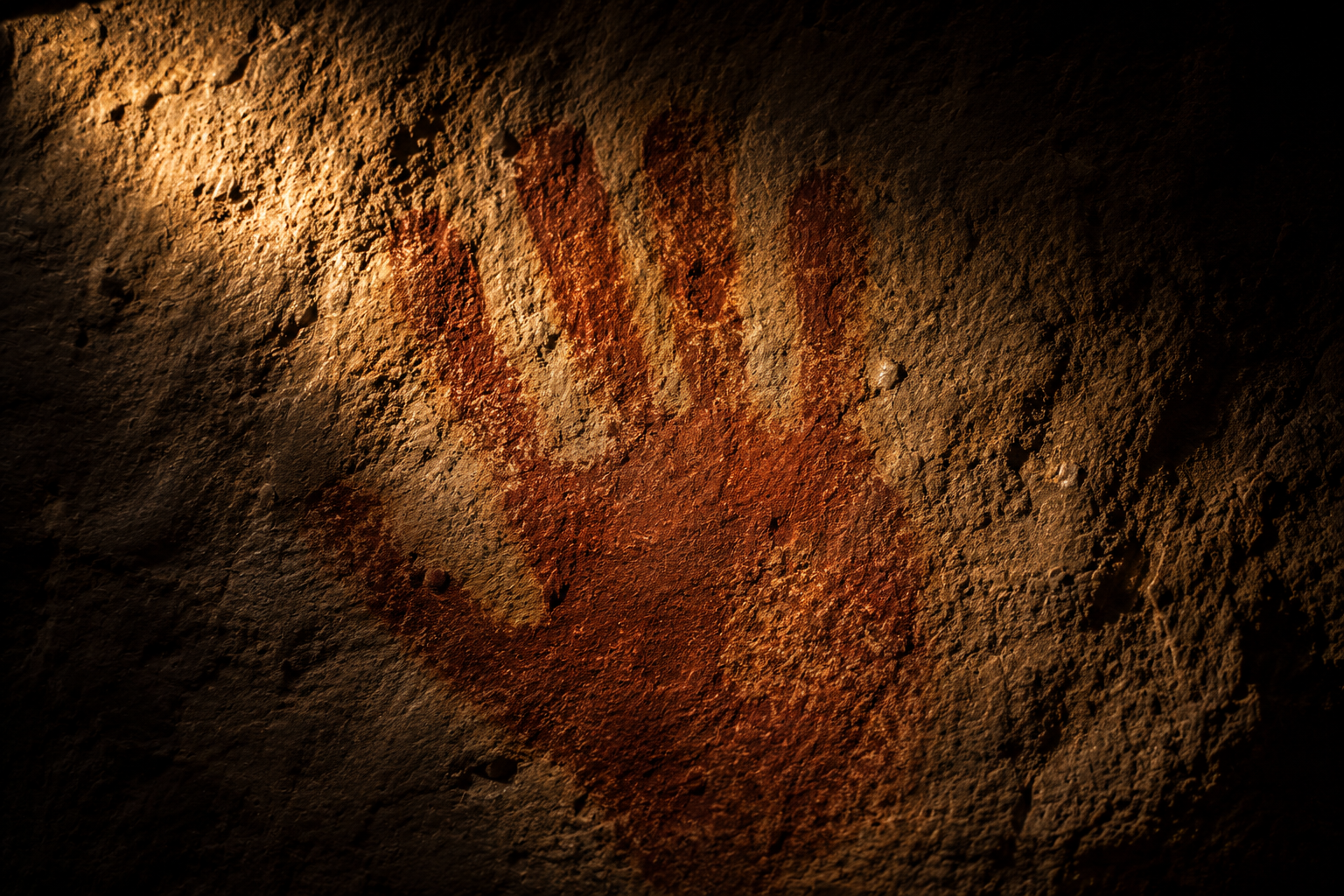
We began with a hand pressed against stone in the dark.
Thirty thousand years ago — maybe more, the dates keep moving backward as we find more — someone crawled deep into a cave in what is now France or Spain or Indonesia, mixed ochre and animal fat into paint, pressed their palm flat against the rock, and blew the pigment around it.
And left a hand.
Their hand. Specific. Unrepeatable. The hand of a person who would never be remembered by name, whose language is gone, whose people are gone, whose world is so far beneath ours that we can barely imagine it, and yet:
I was here.
That's what the hand says. That's all it says. That's everything it says.
I was here, and I was somebody, and I needed you to know that even though I knew you would come long after I was gone and you would not know my name and the world I lived in would be as foreign to you as the surface of another planet.
I was here.
That impulse — the need to mark the sacred, to say I existed and it mattered, to reach across the darkness toward something larger than a single life — that impulse is older than writing. Older than agriculture. Older than cities. Older than every religion that has ever claimed to have invented it.
It is the oldest thing about us.
And it has never stopped.
Before the Flood
We are older than we think.
The standard story goes like this: humans were hunter-gatherers for most of prehistory, living in small bands, barely surviving, until agriculture arrived around ten thousand years ago and civilization began. Writing, cities, religion, philosophy — all of it recent. All of it the product of settled life and surplus grain.
But the ground keeps disagreeing.
Göbekli Tepe, in what is now Turkey, was built at least twelve thousand years ago — before agriculture, before cities, before anything the standard story says should have been possible. Twenty-ton limestone pillars, quarried and moved and carved with animals and symbols by people we used to call primitive. It is not a settlement. It is not a granary. It is a sanctuary. A place people traveled to specifically to do something with the numinous.
They had the questions before they had the answers. They built the temple before they built the house.
And then, around ten thousand eight hundred years ago, something happened.
The climate collapsed. Rapidly, catastrophically, in ways that would have felt like the end of the world because for the people living through it, it was. The Younger Dryas. Glacial lakes drained. Sea levels rose. Coastlines that had been inhabited for millennia went underwater. Entire worlds, if they existed on those coasts — and the evidence is increasingly suggestive that they did — went down with them.
Every culture on earth remembers the flood.
Sumer. India. The Americas. China. Greece. The Hebrew scriptures. The Norse sagas. Everywhere you look, the same story: water came, the world ended, a remnant survived, and everything had to be rebuilt from nothing.
We used to call these myths. We are beginning to understand that they are memories.
The people who survived carried something with them out of the water. Not just tools and seeds and the practical knowledge of how to stay alive. They carried the questions. The hand pressed against the stone. The ochre and the firelight and the sense — stubborn, unkillable, older than any institution that ever tried to manage it — that this is not all there is.
They always do.
Something happened between 800 and 200 BCE that has never been fully explained.
Across cultures that had no contact with each other, with no shared language, no shared trade routes, no way of knowing what the others were doing — something cracked open simultaneously.
In India, Siddhartha Gautama sat under a tree until he understood the nature of suffering and the possibility of its end.
In China, Confucius was teaching the ethics of the interior life, and Laozi was writing about the way that cannot be named.
In Persia, Zoroaster was describing the cosmic struggle between light and darkness and the human responsibility to choose.
In Israel, the Hebrew prophets were insisting that God was not a tribal deity who could be bought with sacrifices but a moral force that demanded justice for the widow and the orphan and the stranger at the gate.
In Greece, the pre-Socratics were asking what the world is actually made of, and Socrates was dying rather than stop asking questions, and Plato was writing down the memory of a man who believed the soul was older than the body.
The philosopher Karl Jaspers called this the Axial Age. The axle around which human consciousness turned. And what turned, in every case, was the same thing: the attention moved inward. The question stopped being how do I appease the gods and became how do I live.
Nobody coordinated this. Nobody sent a memo. Something in the human story reached a certain point and the same fire broke out in a dozen places at once.
That fire has never gone out.
It has been contained, managed, institutionalized, co-opted, persecuted, driven underground, and declared finished more times than can be counted. It keeps coming back. Because it isn't something that institutions produce. It's something that human beings carry, and it surfaces wherever human beings are honest enough to stop pretending it isn't there.
The Axial Age
The Mystic Underground
Every tradition has an interior stream.
Beneath the doctrine, beneath the institution, beneath the hierarchy and the orthodoxy and the enforcement mechanisms and the promotional t-shirts, there is always a current of people who went too deep for the institution to follow, and kept going anyway.
The Essenes withdrew to the desert at Qumran and built a community around the interior life two centuries before the common era. The desert fathers and mothers followed them into the Egyptian wilderness in the third and fourth centuries, discovering that silence was not the absence of something but the presence of everything that noise drowns out.
The Gnostics insisted that the divine spark lived inside the human being and did not require institutional mediation to be accessed. The institution called them heretics and burned their books. Forty-five of those books turned up in a clay jar in Egypt in 1945, buried by someone who understood that truth survives if you give it somewhere to hide.
The Sufi poets — Rumi, Hafiz, Ibn Arabi — found God in the wine and the beloved and the reed flute's cry, in places the orthodox would not look, and wrote about it in language so beautiful that even people who didn't believe what they believed couldn't stop reading it.
The Kabbalists mapped the interior cosmos with a precision that would take centuries to fully understand, tracing the emanations of the infinite into the finite, the way the light bends as it enters the world we can touch.
The Celtic church — the Christianity of Dyffrig and Brigid and Columba and Patrick before he became a greeting card — built its theology on the premise that the sacred was already present in the created world, that every stream and stone and turning season was a word in God's vocabulary, that the monastery was not a retreat from the world but a way of paying closer attention to it.
The Rhineland mystics — Meister Eckhart, Hildegard of Bingen, Julian of Norwich — described an interior encounter with the divine so immediate, so unmediated, so dangerously direct that the institution could barely tolerate them. Eckhart was condemned. Hildegard was ignored for centuries. Julian wrote her revelations alone in an anchorite's cell and somehow they survived.
John of the Cross was imprisoned by his own order in a six-foot cell in Toledo, Spain for nine months for the crime of taking reform seriously. In that cell, or shortly after escaping it, he wrote poetry that remains among the most precise and devastating maps of the interior life ever produced. The dark night of the soul is not depression, though it can wear depression's face. It is the stripping away of every consolation, every manufactured sense of the divine, every spiritual comfort the ego constructed to feel safe — not as punishment, but as the only way through to something realer. The soul emptied so that what actually is can fill it. Anyone who has walked through deconstruction knows this territory. John of the Cross walked it first and left a trail.
The Baal Shem Tov walked into the forests of Ukraine in the eighteenth century and found God there without apology. He taught that the prayer of the unlearned shepherd boy who could only whistle was worth more than the rote recitation of the learned, because the whistle came from a pure heart and God, it turns out, prefers the real thing. He danced. He told stories. He made the sacred accessible to people the institution had written off as too simple to understand it.
He was not the first. He will not be the last.
Thomas Merton entered a Trappist monastery in Kentucky in 1941 looking for God and found, to his and everyone's surprise, that the further he went into Christian monasticism the more he found himself in conversation with Zen Buddhism, with Sufism, with the universal current that runs beneath all of it. His last journal entries were written in Bangkok. He died in Asia, in dialogue, having discovered that the walls between traditions are only as solid as the people defending them.
Thich Nhat Hanh spent his life demonstrating that the walls are permeable to anyone willing to sit still long enough. He called it interbeing. The idea that nothing exists in isolation, that everything is woven into everything else, that the flower contains the cloud and the cloud contains the ocean and the ocean contains you.
Emanuel Swedenborg, scientist and mystic, mapped the interior cosmos with the same precision he had once applied to mineralogy and anatomy, and described a universe in which the natural world is the language of the spiritual world, in which everything outer corresponds to something inner, in which the divine is not somewhere else but woven into the fabric of what is.
William Blake saw angels in the trees on Peckham Rye when he was a child and never stopped seeing them and never apologized for it.
These are not eccentrics. These are not the footnotes of history. These are the people who kept the fire lit when the institution let it go out. Who kept asking the questions when the institution declared the questions settled. Who kept the table open when the institution was busy deciding who was allowed to sit at it.
They are your people.
They are our people.
In 1645, a rector named John William Jones boarded a ship called the Merry Widow in Cardiff and sailed to Charleston.
He came from Monmouthshire — the Welsh borderlands, the shadow of Tintern Abbey, the country of the Celtic saints. His family were the Phillipses of Wrexham. He carried with him, though he could not have known it, the end of something.
He became a farmer. His children became farmers. Their children became farmers, and carpenters, and blacksmiths, and eventually hydraulics men and network engineers. The ministry went quiet. The language went quiet. Wales itself went quiet, buried under three and a half centuries of American assimilation until it was nothing but a vague sense that Welsh Rabbit was apparently something with cheese.
The thread went underground.
It did not break.
Because the pull remained. Inexplicable, persistent, embarrassing in the context of a megachurch that kept handing out promotional t-shirts. The pull toward the monastery, toward the Hours, toward the silence, toward the table that asks nothing of the person sitting down except that they show up.
The last rector's descendant drove out on weekends to sit with Cistercian monks. Watched documentary series about Benedictines. Spent time as a Franciscan oblate. Founded a small Celtic order in a storage shed. Hand-stitched a denim habit. Wore a Celtic pectoral cross over it and went to work in a downtown skyscraper and answered questions about it with name, rank, serial number and a kind smile.
And accepted the person nobody else would accept. And built the table nobody else was building. And heard his father weep at the sound of his real language and say we ARE somebody and understood, finally, what the thread had been all along.
The Thread Goes Underground
We Are Not New
Wayfarer House is not a new idea.
It is the oldest idea there is, wearing new clothes.It is the hand pressed against the stone in the dark, saying I was here.
It is the sanctuary built before the city, the question asked before the answer, the fire that keeps breaking out in new places because it cannot be permanently extinguished.
It is the mystic underground surfacing again, as it always does, whenever the institution gets too heavy and the people who need the real thing go looking for it outside the walls.
We are the Essenes without the desert. The Celtic church without the geography. The Baal Shem Tov's table without the Ukraine. Merton's dialogue without the monastery. The shepherd boy's whistle without apology.
We are everyone who ever felt the pull of something serious and found no container for it in the world they were handed.
We are everyone who built something alone because the institution didn't have a room for what they were carrying.
We are everyone who sat under a night sky and felt something that didn't have a name and decided that the feeling was more trustworthy than the name.
The thread is long.
You are on it.
You always were.
The wilderness is shared. The table is open. The seat is yours.
You never had to earn it.