
The Denim Tunic
On being too serious about the wrong things in the right direction.
I built it before I wore it.
I’d seen how it was done in a documentary called Into Great Silence — a film about Carthusian monks who barely speak, who pray in the dark before dawn, who have decided that the interior life is worth the full cost of the exterior one.
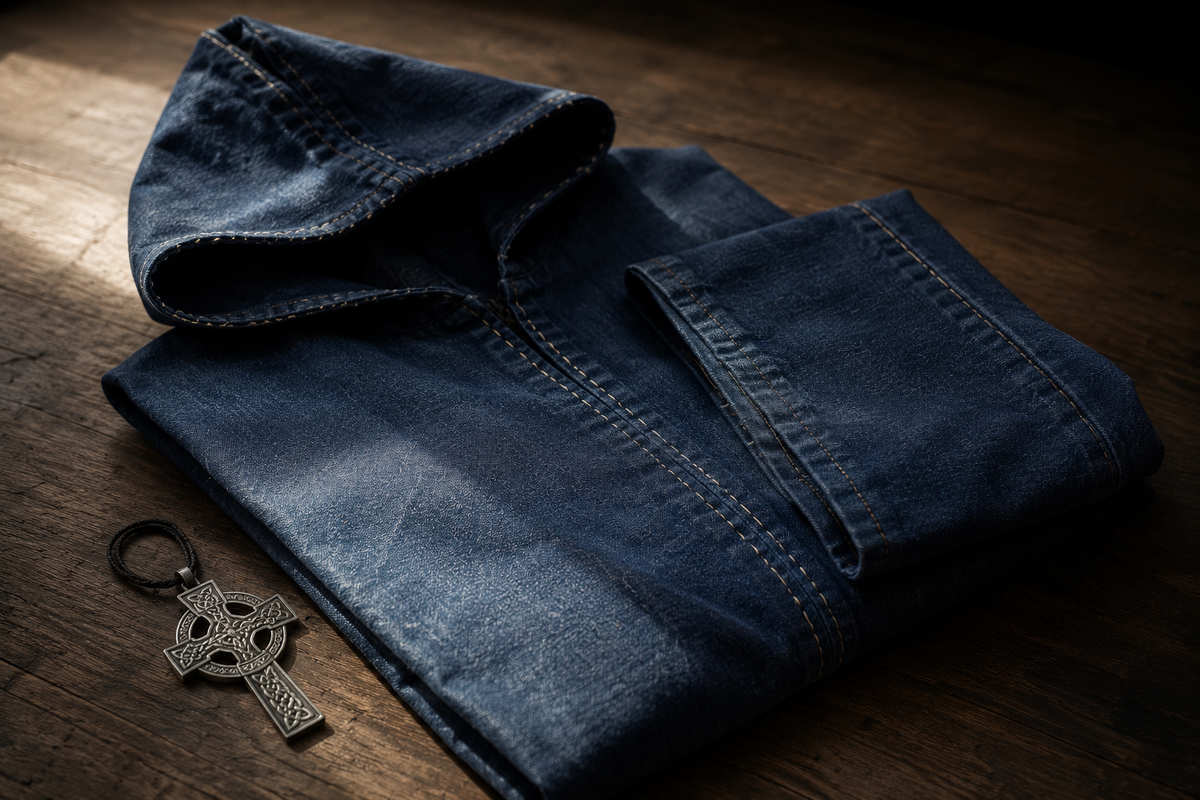
I found a pattern online. Drew it out on paper, each line deliberate. Transferred it to raw denim. Cut it like a kilt — something that isn’t clothing so much as identity, something that comes from the blood before it comes from the fabric.
Every scissor stroke was a prayer. Every move of the needle.
Over it I wore a Celtic pectoral cross — not the Roman cross of conquest and empire, but the older one, the circle holding the arms, the cosmos gathered into the sacred, eternity and the present moment held in a single mark.
Dyffrig’s cross. The pre-Roman church’s cross. The cross that said the world is held, not subdued.
I hand-stitched it. The same devotion and contemplation in every pull of the thread that a monk puts into the Hours, that a scribe puts into a manuscript, that anyone puts into anything when they understand that the how is the what.
When I put it on for the first time, it felt like taking on the mantle of the world itself.
Not because anyone asked me to. Not because it would bring me favor, or fame, or a larger platform, or a better seat at any table I was trying to get into.
Because it felt like the right thing to do that no one else was doing because no one else had to.
Part exhilaration. Part sadness. A flash of fear and panic at what I was saying with the action.
My wife was pregnant. We lived in a storage shed we had converted into a house. We were part of a megachurch.
They did not understand.
Name, Rank, Serial Number
The first person outside my household to comment on it was a coworker in a downtown skyscraper.
He looked at it, made a face, and said: “That’s a weird looking hoodie. Where did you get THAT from?”
I said: “It’s a habit. I hand made it.”
That ended the conversation. He never asked again.
I had prepared myself for exactly this. I had decided, before the first time I walked out the door wearing it, that no one would understand, that it was my deal between me and God, and that I would respond to any inquiry the way a prisoner responds to interrogation:
Name. Rank. Serial number.
The shortest possible amount of information, delivered with a kind smile and a soft answer, and then I would move on.
This is, it turns out, a profound spiritual posture that most people spend a lifetime trying to reach and never quite get there.
The mystics call it hiddenness. The interior life practiced without an audience. Jesus named it directly in the Sermon on the Mount: don’t do your praying on the street corner. Your father who sees in secret will reward you openly.
I wasn’t performing devotion. I was practicing it. The distinction matters more than almost anything else I have ever learned about the spiritual life.
We’re Wearing These Today
The coworker in the skyscraper was innocent. He saw something unfamiliar and named it badly. That’s just being human. No malice. Just the limits of the frame he had available.
The church was a different story.
They didn’t ask a single question.
Not what is that. Not why are you wearing it. Not what does it mean to you. Not tell me about this practice you’ve taken on.
They produced a t-shirt with their logo on it and told me what I’d be wearing publicly for the service.
“We’re wearing THESE today.”
I want to sit with that for a moment, because I think it contains something important.
They weren’t being cruel. That’s almost the harder thing to hold. They weren’t threatened, or offended, or even particularly interested.
They were managing the public image. Keeping things uniform. Solving a branding problem.
The institution’s relationship to my interior life was, in the end, a question of optics — of what the congregation looked like to whoever might be watching that day.
There’s a version of church that treats you as a participant in something sacred, and there’s a version that treats you as an audience member to be wooed, or a cast member dressed for the part. I had shown up having hand-stitched a prayer into every seam of a garment representing a covenant I had made with whatever force holds the universe together.
They handed me a promotional t-shirt.
I was trying to live like Christ. I was smack dab in the middle of my own dark night of the soul. They were just trying to match their uniforms.
Formation
The tunic didn’t come from nowhere. Nothing real ever does.
It came from a season that had been building for years, quietly, without a name.
It came from driving out on weekends to a Cistercian monastery not far from where we lived — sitting in the guest chapel, listening to the chant, feeling something settle in my chest that the megachurch with its lights and its logo t-shirts had never once touched. The monks didn’t know I was there. Nobody was performing for anybody. The Hours turned. The silence held. I kept coming back.
It came from two BBC documentary series on the Benedictines — programs that showed the monastery not as a relic or a curiosity but as a living thing, a community of people who had simply decided that the interior life was worth organizing an entire existence around. I watched them the way some people watch those series more than once. I took notes.
It came from spending time as a Franciscan oblate — not a monk, not a full member of the order, but an affiliate. Someone who takes on a rule of life adapted for living in the world. Francis made sense to me in a way that the suburban evangelical project never had. The poverty. The creation as sacred. The leper he kissed. The wolf he befriended. The birds he preached to in a field because the field was as good a cathedral as any building ever built.
Monastic orders in evangelical denominations are rare. Not because evangelicals lack devotion — many of them are among the most devoted people I have ever known — but because the tradition never developed the container for that particular kind of seriousness.
So I built one.
I called it The Dubricians. The Order of Saint Dyffrig of Wales.
Dyffrig — Dubricius in Latin — was one of the earliest Celtic Christian saints. Pre-Roman. Pre-the-church-that-told-everyone-what-God-looked-like. Rooted in a Christianity that was comfortable with the natural world, mystical rather than institutional, that didn’t need Constantinople or Rome to tell it where the sacred lived.
He was the right patron for an order founded in a storage shed by a man in a hand-stitched denim habit whose megachurch kept handing him t-shirts.
I knew it would look odd. I wore it anyway.
Because something in me understood — has always understood — that more was required. Not of everyone. Of me. And I accepted that.
The Table
I am not the only one who has ever felt this way.
There are people sitting alone right now in apartments and farmhouses and suburban bedrooms who feel the pull of something serious, something that costs something, something that the institution they grew up in either never offered or actively punished them for wanting.
The woman who wanted to learn the ancient prayers and was told that wasn’t for her kind.
The man who built a small altar in the corner of his study and told no one, because the last time he mentioned his practice someone laughed.
The person who left the only spiritual community they had ever known — not because they stopped believing, but because the community stopped believing in them. Their body, their love, their questions, their doubts suddenly disqualifying them from the table they had eaten at their whole lives.
I knew someone like that once.
I was serving as a lay rabbi at the time, leading Friday night Shabbat services for an online shul while the rabbinical student who founded it worked the larger synagogues. That’s just how it worked. I was the one actually in the room — or in this case, on the screen — every week, and a trans person came to us that no one else would accept. Nobody asked me to take them in. No policy required it. No denominational guideline covered the situation in any productive, spiritually useful way.
I just figured: if this is a problem, it’s God’s problem to sort out. My job is the table. My job is to make sure there’s a seat.
What happened next is the part I don’t tell often enough.
They didn’t just join the community. We ended up sharing a house. They gave us the entire bottom floor — unoccupied, offered freely — and we helped with the bills. They were showing us charity at the same time we were showing them acceptance. Nobody was the benefactor. Nobody was the charity case. We were just people with not quite enough, pooling what we had, making something that worked.
That’s not a ministry success story. That’s just two households finding each other.
That’s what the table actually looks like when nobody’s keeping score.
I don’t know where they are now. It’s been more than a decade.
But I think about them when I think about who Wayfarer House is for. Not as an abstraction. Not as a demographic or a mission statement or a target audience.
As a specific human being who needed somewhere to sit that wasn’t trying to extract something from them, wasn’t going to hand them a t-shirt and tell them what they’d be wearing today, wasn’t going to make their belonging contingent on anything except showing up.
And who, it turned out, had something to give right back.
Harvey
When we moved to Texas, I had to stop wearing the habit.
Manual labor. Construction sites. OSHA.
I put it in storage.
Then Hurricane Harvey came through and took care of it.
I won’t pretend that didn’t hurt. It did.
Every scissor stroke a prayer. Every move of the needle. And then water and wind and the indifference of weather.
But here is what I have come to understand, in the years since the storm took the denim:
The habit was never the point.
The habit was the visible form of something interior that water cannot touch.
The Carthusians who inspired it understood this better than almost anyone. They wear the same rough cloth for a reason — not to perform austerity, not to signal holiness, but to stop having to think about the outside so the inside can do its work.
When the outside goes, the inside remains.
Harvey got the denim.
It didn’t get what the denim meant.
What Remains
I don’t wear a habit anymore.
My theological home has shifted over the years — more universal now, more Pagan in the oldest sense of that word, more comfortable with the sacred as something woven into the world itself rather than descending into it from outside. Merton got there. Thich Nhat Hanh was already there. The Baal Shem Tov never left. Swedenborg mapped it in his own extraordinary way. The further you go into any of these forests, the more you find they share the same root system underground.
One reaches a distance and increment of extraction that they can more clearly see the woeful maxim: Lord, save me from your followers.
No matter who that “Lord” may be.
But I still have the medal of Saint Benedict hanging in my vehicle.
I haven’t been able to take it down.
Not because I’m afraid to. Not out of habit or superstition. But because the Benedictine medal is doing exactly what it was always doing — holding a piece of the formation. Benedict’s Rule pressed into metal. Ora et Labora. Pray and work. Welcome the stranger. Don’t be cruel. Get enough sleep. The cross in the center. The circle around it.
The Wheel of the Year and the Liturgy of the Hours are not as different as they look. They’re both just ways of saying the same thing: pay attention to time. Mark the turning. Don’t let the days blur into nothing.
I kept the medal because some part of me knows that.
The Order of Saint Dyffrig of Wales still exists.
Not with a habit. Not with a formal rule, though Benedict’s Rule lives on my shelf and I return to it the way you return to anything that tells you the truth about how to live.
It exists in a calendar that honors every tradition that ever pointed toward the sacred — the Wheel of the Year and the Jewish month and the Islamic fast and the Hindu lamp and the Celtic saint and the Norse goddess and the Buddhist full moon and the feast days of the people who lived so seriously that their lives became doorways.
It exists in the decision to make this table free. No t-shirts. No logo. No membership fee. No credentials required. No body disqualified. No question too dangerous. No doubt too large.
It exists in this:
Wayfarer House is what the denim tunic became when the storm took the denim.
You are not the only one who feels the pull of something serious.
You are not the only one who has been handed a t-shirt when you showed up with a covenant.
You are not the only one who built something alone in a storage shed because the institution didn’t have a container for what you were carrying.